Guild Certified Feldenkrais PractitionerCM · Kirkland, WA
I’m Laura.
I help people learn to move better.
Perhaps you’ve tried physical therapy, massage, yoga, or exercise, and pain still limits what you do, e.g., walking, gardening, climbing stairs, getting up off the floor. Together, we’ll look at how you’re moving now and find ways to make daily activities easier and less painful.
55 minutes, in person in Kirkland. I’ll tell you whether I can help. No obligation.
My approach
I named my practice Kinetic Inquiry because inquiry is where it starts. Our brains are always making the best decisions they can given their current information and training. If we want better decisions, we need better information.
Better information about how we move starts with noticing the subtle details we rarely attend to. For example, most of us are not paying attention to what our glutes do as we take a step, or to how our shoulder blade is involved with lifting our arm.
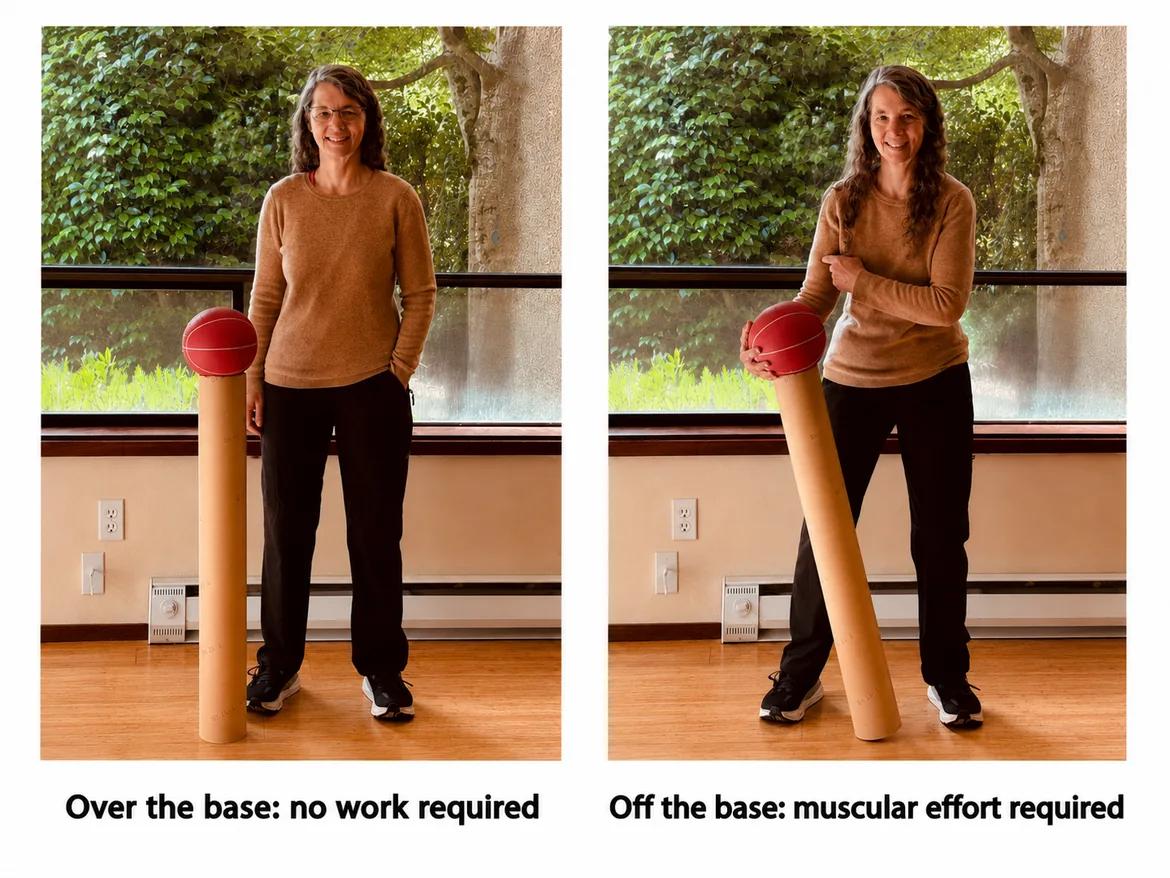
We also need better conceptual models to help understand how the subtle somatic details we discover fit into a larger picture. For example, most clients are accustomed to thinking about movement solely in terms of muscles. The photo shows a model I built to make the case for the skeleton: a ten-pound medicine ball for the head, and a mailing tube for a simplified skeleton. People are surprised to learn how heavy their head is. Shifting attention to the skeleton changes what they notice.
My job is to create the conditions that allow you to learn. This includes making sure you feel safe and comfortable. It also includes modifying the level of difficulty. Learning happens on a fine edge between too easy and too hard. If what I’m asking for is too easy, there is nothing to learn. If it is too hard, we just create frustration. My job is to keep us on this fine edge, and when that happens, learning is engaging and fun.
Laura has a knack for asking questions of her clients (verbally and with touch) that lead them to discover abilities they do not know they have.
Jeff Haller, Feldenkrais Trainer
Why I became a Feldenkrais® practitioner
After I left Microsoft in 2000, I fell in love with racquetball. But the more I played, the more I strained my hamstrings, until even walking hurt.
I worked with several physical therapists for over two years. They all agreed that my glutes were weak and my hamstrings were doing too much of the work. They prescribed glute-strengthening exercises that I did daily. My glutes got stronger. But on the court, I kept overusing my hamstrings. Physical therapy helped. It was not enough.
Finally, a friend convinced me to try Feldenkrais. I learned how to engage my glutes while I played, and my hamstrings got a chance to recover. My movements became more powerful and fluid. I won more games.
Even after my hamstrings stopped being an issue, I kept going. My posture and my sense of ease improved. At times it felt magical, and I wanted to know how it worked.
Over 4,000 private lessons since 2012
My training to become a Feldenkrais practitioner was extensive and rigorous. I graduated from an 800-hour, four-year program (2009–2012), and have taught over 4,000 private lessons since. In addition, I have completed over 1,500 hours of continuing Feldenkrais education. I am committed to continually refining my skills and improving myself to provide the best support possible to my clients, my family, and myself. The full list, including meditation and other training, is on my education page.
I also helped design and staffed two Feldenkrais programs:
- The four-year Feldenkrais Training Academy in Seattle, WA (2018–2022)
- The IOPS Academy, an 18-month advanced program for Feldenkrais practitioners. I staffed its first four programs: Basel (2019–2021), Buenos Aires (2017–2019), Seattle (2016–2018), and New York (2015–2017).
Before becoming a Feldenkrais practitioner, I spent 20 years in the computer industry, first as a programmer, then as a manager, and finally as Group Manager of the Natural Language Group at Microsoft.
My subject has changed from computers to human movement, but the questions that interest me haven’t: how does it work, and how can it work better?
“Laura is a geek about the human body and the optimal way for it to move. She’s helping me retrain myself so I move with greater power and less pain.”
Lisa Cranston
You can read what other clients say on the testimonials page, and follow several of them from what brought them in to what changed on the success stories page.
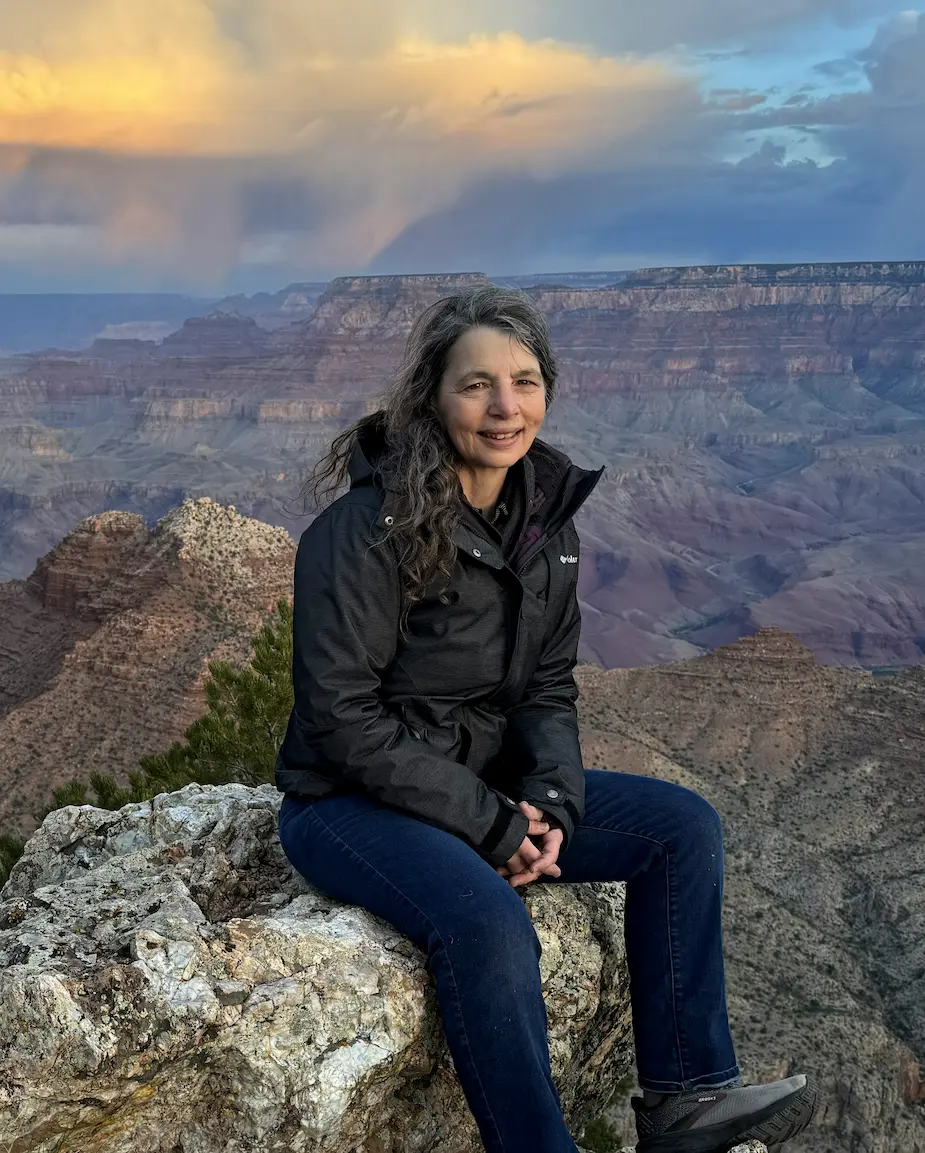
Fun facts
I’m a technologist, Feldenkrais practitioner, meditator, mother, former Go player, and lifelong student of how people think, move, learn, and change. Some fun details about me:
- I received a master’s in computer science from MIT in 1985, at a time when women were still rare in the field.
- In 1989, I represented the United States in the World Women’s Amateur Go Tournament for the Yokohama-Sotetsu Cup.
- As a young adult, I traveled widely: Australia, Costa Rica, Egypt, Europe, Greece, India, Indonesia, Israel, Japan, Nepal, New Zealand, and more. These days, travel has less pull for me. The old joke explains it well. What’s the difference between a traveler and a tourist? A traveler has little money and lots of time; a tourist has lots of money and little time. I seem to have become a tourist.
Ready to see if we are a fit?
You’ve read a lot about how I think. The consultation is where we look at you: what you’re doing now, what you can already feel, and what you can’t.
Book a free consultation55 minutes, in person in Kirkland. I’ll tell you whether I can help. No obligation.